Who could be behind hoax bomb threats to European air travel?
Article text
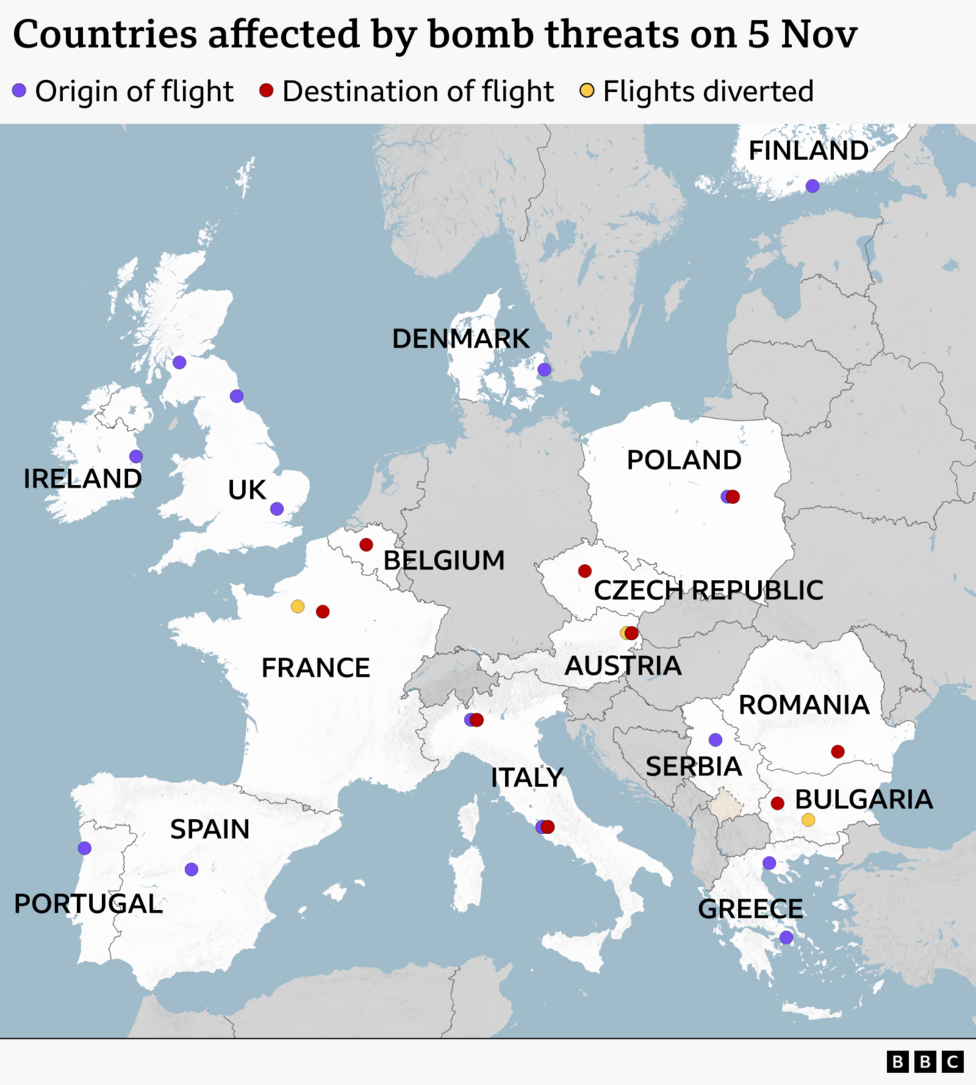
15 paragraphs · Tap (click) a word or select text to translate · Tap a word or select text to translateThe warnings came in thick and fast, targeting one airline or airport after another.
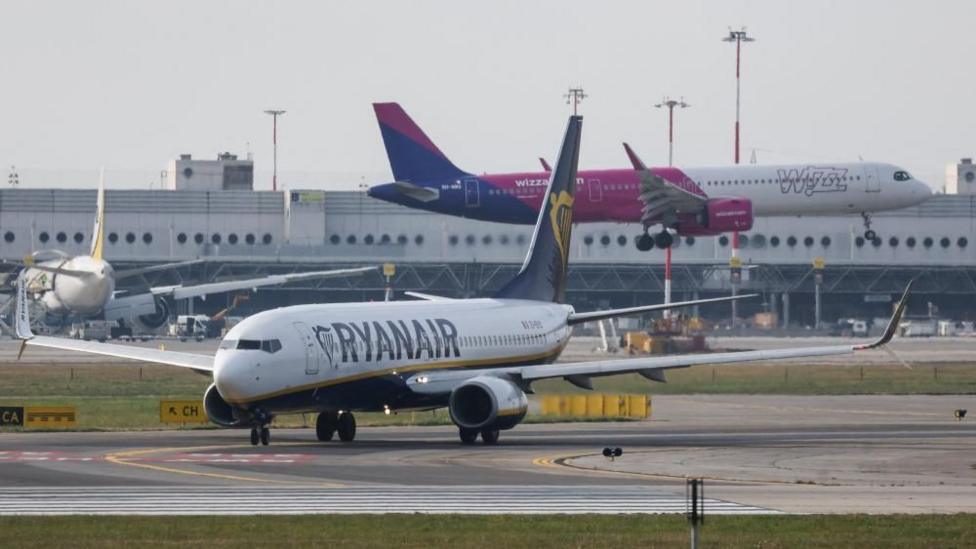
In nearly all cases - London's Heathrow airport being a notable exception - they were taken to be credible enough to divert the aircraft in question, or even in Italy's case, to scramble fighter jets to escort it.
They all turned out to be false, which does not, of course, mean that the next ones will not be real.
It is hardly surprising that the simultaneous, co-ordinated nature of these airline hoaxes, coupled with other malicious actions across Europe, are causing some people to point the finger of suspicion at Russia.
Following a series of cyber-attacks and mysterious drone sightings over sensitive sites earlier this year, in the past few days we have seen the remote hacking of supermarket freezers, as well as a blood bank, a suspicious incident on Poland's border with Russia, and in August a drone attack Germany's Leipzig Halle airport which its interior minister publicly blamed on Moscow.
So is Russia behind this?
There are many who argue, based purely on circumstantial evidence, that this must surely be yet another example of "hybrid", "grey zone" or "sub-threshold" warfare - actions that damage a nation's infrastructure or society but which tend to be anonymous, deniable and which fall short of triggering Nato's Article 5 and thereby mobilising a response by the West.
Moscow is certainly furious with Nato for supporting Ukraine and, in doing so, frustrating the Kremlin's plans to swallow up that country and effectively terminate its independence.
Russian bloggers have also suggested that, if Ukraine's drones are currently making Russia's airports unsafe, and Western sanctions are blocking Russian airlines from European airspace, then why shouldn't Western nations feel the same pain?
But as of Thursday evening no hard evidence had emerged linking the airline hoaxes to Russia, Iran or any proxy groups controlled by them.
There is the email threat sent on Thursday morning to airport authorities in Rome, purporting to be from "Fighters of the Male State".
That name likely refers to the Russian group Muzhskoi Legion or "Male Legion", an ultra-right group with such extreme views it was banned by a Moscow court in 2021.
Yet, it retained tens of thousands of online followers on Telegram as it cheered on the full-scale Russian invasion of Ukraine in the following year.
But the email sent to Rome, even if genuine - and who is to say it is not another group hiding behind that name? - is unlikely to provide the leads that police and airport authorities need to pin down who is generating these hoaxes and why.
For national police forces, airport authorities and transport ministries trying to work out who is behind these hoaxes and how best to mitigate their effect when they happen again, the task is not to go with who they think might be the most likely culprits but instead to follow the cold, hard leads - if they can find them.
For when the paragraph translations don't line up
Full translation
Image from this article 1
Tap (click) a word to translate it, or select text to translate that passage straight away.